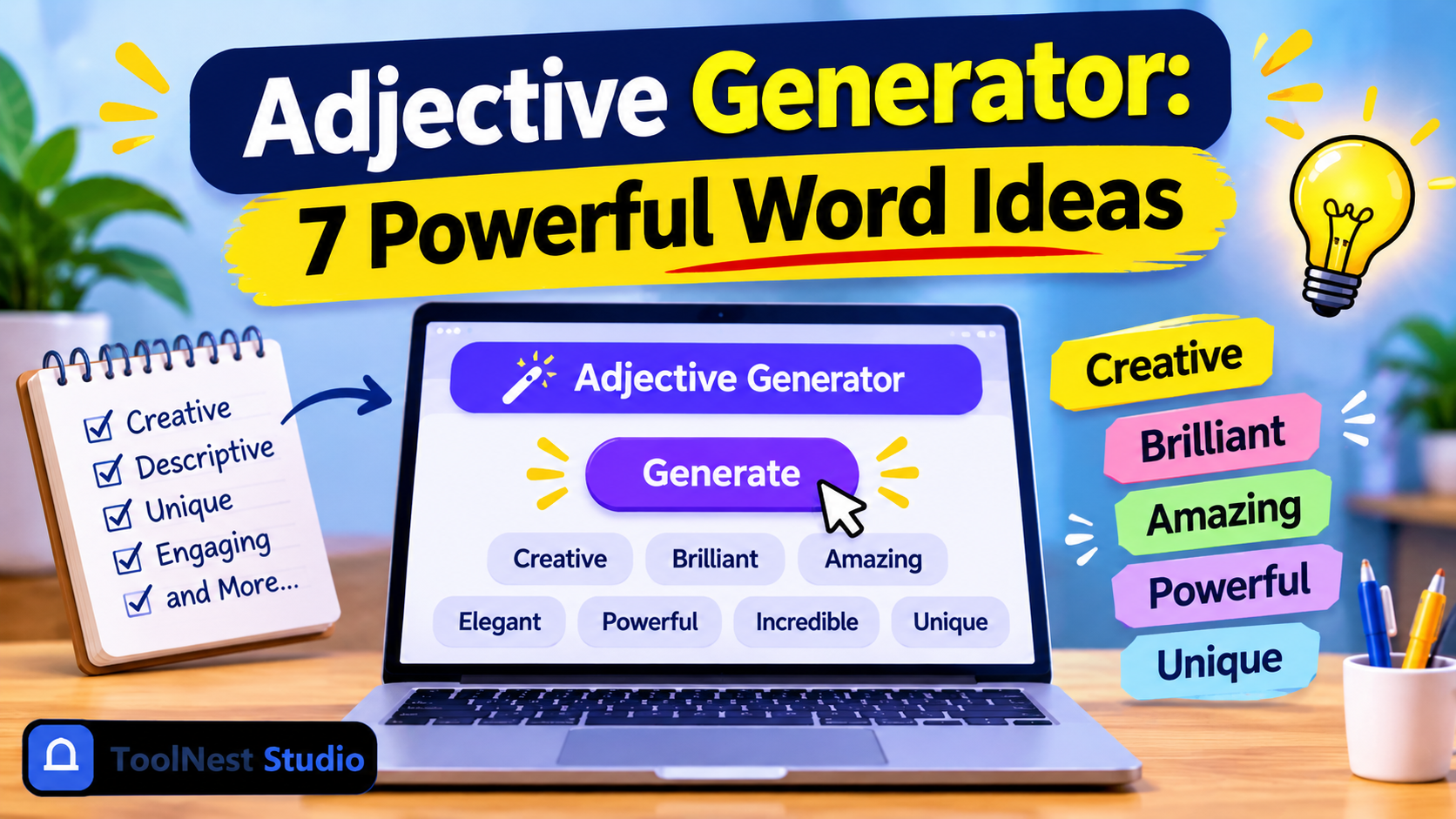
Adjective Generator: 7 Powerful Word Ideas
An Adjective Generator helps you discover descriptive words for writing, learning, and creative projects. It can give you fresh ideas when you cannot find the right word to describe a person, place, object, or feeling.
Adjectives make sentences more meaningful. They help readers understand what something looks, feels, or sounds like. However, finding the right adjective can sometimes be difficult.
A random adjective generator can make this process easier. It provides different word ideas that you can use in stories, school assignments, descriptions, and everyday writing.
In this guide, you will learn what adjectives are, how they work, which types are useful, and how to choose better descriptive words for different writing tasks.
What Is an Adjective Generator?
An adjective generator is a tool or resource that provides descriptive words based on different writing needs. It helps users find adjectives for sentences, stories, descriptions, and vocabulary activities.
For example, you may need a word to describe a beautiful place or an interesting character. Instead of repeating common words, you can explore new options such as peaceful, charming, mysterious, or fascinating.
An online adjective generator can be useful for students, teachers, writers, bloggers, and anyone who wants to improve their vocabulary.
What Does an Adjective Do?
An adjective describes or gives more information about a noun or pronoun. It can explain its size, color, shape, appearance, condition, or quality.
For more details, read this guide to Adjectives and Adverbs by Purdue OWL.
For example:
- The beautiful garden looks peaceful.
- She bought a red dress.
- It was a difficult question.
- The small puppy followed its owner.
In these examples, the bold words describe the nouns and make each sentence clearer.
7 Useful Ways to Use an Adjective Generator
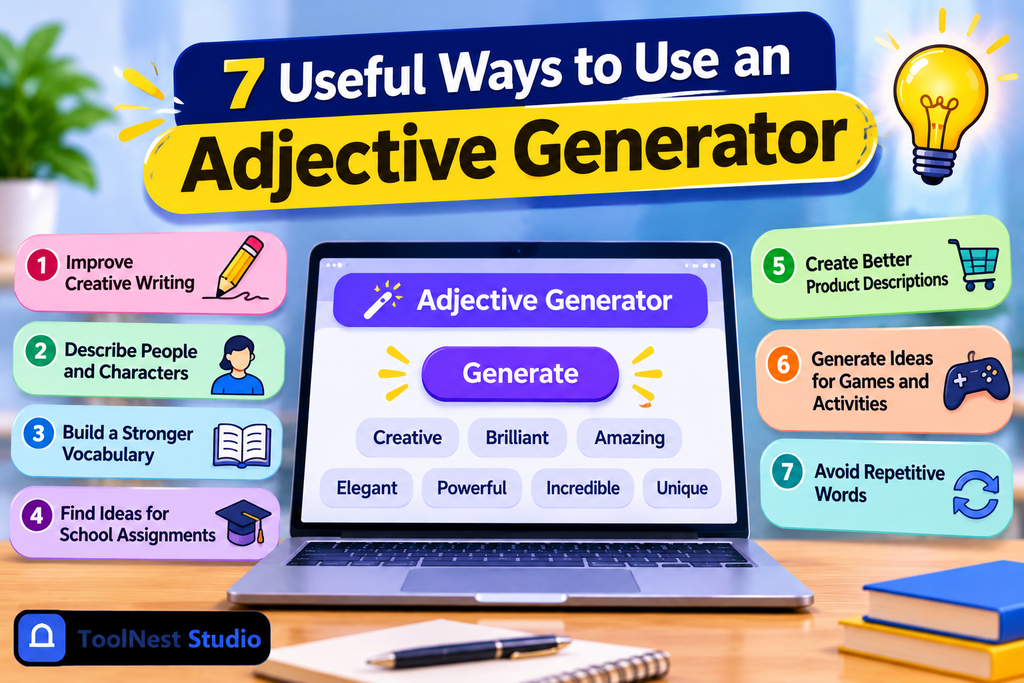
An adjective generator can support different writing and learning activities. Here are seven useful ways to explore descriptive words.
1. Improve Creative Writing
Creative writing often requires interesting descriptions. Adjectives help writers create clear pictures in readers’ minds.
For example, instead of writing “a house,” you could write “an old wooden house.” The extra details make the description more interesting.
You can explore descriptive words such as mysterious, peaceful, ancient, colorful, and beautiful to develop better story ideas.
2. Describe People and Characters
Adjectives help explain someone’s appearance, personality, and behavior. They are useful when creating fictional characters or describing people in general.
Here are some examples:
- Friendly
- Confident
- Honest
- Creative
- Patient
- Brave
- Cheerful
A positive adjective generator can help you explore words that describe good qualities. You can also use neutral or negative adjectives when the context requires them.
3. Build a Stronger Vocabulary
Learning new adjectives can improve your everyday communication. It also helps you avoid using the same descriptive words repeatedly.
For example, instead of always using “good,” you can learn words such as excellent, impressive, wonderful, or valuable.
Students can create a personal vocabulary list and practice using each new word in a sentence.
4. Find Ideas for School Assignments
Students often need descriptive words for essays, paragraphs, presentations, and classroom activities.
An adjective finder can help them discover suitable words for different topics. For example, a student writing about nature may explore words such as green, fresh, peaceful, beautiful, and natural.
However, students should always understand a word before using it in an assignment.
5. Create Better Product Descriptions
Product descriptions need clear and useful details. Adjectives help explain the appearance, quality, and features of an item.
For example:
- A comfortable chair
- A durable backpack
- A lightweight laptop
- A stylish watch
- A soft cotton shirt
These descriptions help customers understand what makes a product different.
6. Generate Ideas for Games and Activities
Teachers and game organizers can use random adjectives for vocabulary games and classroom exercises.
For example, students can pick three random adjectives and use them to create a funny sentence. They can also combine descriptive words with nouns to create unusual characters or story ideas.
These activities make vocabulary practice more interesting.
7. Avoid Repetitive Words
Repeating the same adjectives can make writing less interesting. Finding alternative words helps you express ideas in different ways.
For example:
| Common adjective | Alternative words |
|---|---|
| Good | Excellent, impressive |
| Big | Huge, enormous |
| Small | Tiny, little |
| Happy | Cheerful, joyful |
| Beautiful | Attractive, lovely |
| Bad | Poor, unpleasant |
Always select an alternative that matches the meaning and tone of your sentence.
Different Types of Adjectives With Examples

Adjectives come in different types. Each type provides specific information about a noun.
1. Descriptive Adjectives
Descriptive adjectives explain the qualities or characteristics of someone or something.
Examples include:
- Beautiful
- Bright
- Clever
- Soft
- Strong
- Quiet
Sentence: The bright room looked welcoming.
2. Positive Adjectives
Positive adjectives describe good qualities, feelings, or experiences.
Examples include:
- Amazing
- Friendly
- Generous
- Helpful
- Kind
- Wonderful
Sentence: She is a kind and helpful person.
3. Negative Adjectives
Negative adjectives describe unpleasant qualities, conditions, or experiences.
Examples include:
- Angry
- Careless
- Cruel
- Lazy
- Rude
- Unpleasant
Sentence: The careless driver ignored the warning.
4. Neutral Adjectives
Neutral adjectives provide information without expressing a clearly positive or negative opinion.
Examples include:
- Average
- Common
- Ordinary
- Regular
- Standard
- Typical
Sentence: She selected an ordinary notebook for class.
5. Quantitative Adjectives
Quantitative adjectives describe the amount or quantity of something.
Examples include:
- Some
- Many
- Few
- Several
- Enough
- Little
Sentence: Several students joined the activity.
6. Demonstrative Adjectives
Demonstrative adjectives identify specific nouns.
The common examples are this, that, these, and those.
Sentences:
- This book belongs to me.
- That building is very old.
- These flowers smell lovely.
- Those shoes are expensive.
How to Choose the Right Adjective for Your Writing
Choosing the correct adjective is important because not every descriptive word fits every situation. A suitable word should match the meaning, tone, and context of your sentence.
Follow these simple tips:
Understand the Meaning
Before using a new adjective, check what it means. Some words may look similar but have different meanings.
For example, “confident” and “arrogant” both describe personality, but they do not express the same quality.
Consider Your Audience
Think about who will read your content. Simple adjectives are often better for school assignments and beginner-level writing.
More specific vocabulary may be useful for creative stories, professional descriptions, and advanced writing.
Match the Tone
Choose adjectives that fit the mood of your content. A positive description may need words such as cheerful or inspiring, while a serious story may require words such as dark or disturbing.
Avoid Unnecessary Adjectives
Using too many descriptive words can make sentences difficult to read. Choose only the words that add useful information.
For example:
Instead of: “The beautiful, lovely, amazing, wonderful garden looked nice.”
Write: “The beautiful garden looked peaceful.”
The second sentence is shorter and clearer.
Adjective Generator for Writing: Practical Examples
A descriptive words generator can help writers explore different vocabulary options. However, the best results come from selecting words that fit the sentence.
Here are some examples:
| Writing purpose | Example adjectives |
|---|---|
| Describing a person | Friendly, honest, confident |
| Describing a place | Peaceful, crowded, beautiful |
| Describing an object | Heavy, smooth, colorful |
| Describing emotions | Excited, nervous, joyful |
| Describing weather | Cloudy, sunny, windy |
| Describing food | Delicious, spicy, fresh |
| Describing animals | Gentle, wild, playful |
You can use these words to create sentences, improve descriptions, or practice vocabulary.
For example, the words “quiet,” “green,” and “peaceful” can help you describe a garden in different ways.
Common Mistakes to Avoid When Using Adjectives
Adjectives improve writing, but incorrect use can make sentences confusing. Keep these common mistakes in mind.
Using Too Many Adjectives
Adding several adjectives to one noun can make a sentence unnecessarily long. Choose the most meaningful words instead.
Repeating the Same Adjectives
Using words such as good, nice, and beautiful repeatedly can make writing sound basic. Explore suitable alternatives to improve variety.
Choosing Words Without Understanding Them
Do not select advanced adjectives only because they sound impressive. Make sure their meanings match your intended message.
Using the Wrong Word Form
Some words have similar forms but perform different grammatical roles.
For example, “beauty” is a noun, “beautiful” is an adjective, and “beautifully” is an adverb.
Understanding these differences helps you write correct sentences.
Ignoring the Sentence Context
An adjective should make sense with the noun it describes. A word that works well for a person may not be suitable for an object or situation.
How to Improve Your Vocabulary and Writing Skills
Finding new adjectives is only one part of improving your writing. You should also practice using them correctly.
Here are some simple ways to build better vocabulary:
- Read regularly: Explore books, articles, and other written content to discover new descriptive words.
- Keep a word list: Save useful adjectives with their meanings and example sentences.
- Practice daily: Write a few sentences using new words.
- Learn synonyms: Explore different words with similar meanings.
- Review your writing: Replace repeated or unnecessary adjectives.
- Use a dictionary: Check the meaning and correct usage of unfamiliar words.
Conclusion
An adjective generator is a useful way to explore descriptive words for creative writing, vocabulary practice, school assignments, and everyday communication.
Understanding different adjective types can help you choose better words and create clearer sentences. Positive, negative, neutral, and descriptive adjectives all have different purposes.
The key is to select words that match your meaning and audience. Avoid unnecessary descriptions, practice new vocabulary, and use adjectives naturally to make your writing more effective.
Frequently Asked Questions
What is an adjective generator?
An adjective generator is a tool or resource that provides descriptive words for writing, learning, and creative activities. It helps users discover new vocabulary and find suitable words for different situations.
How does a random adjective generator help writers?
A random adjective generator gives writers fresh word ideas. It can help overcome writer’s block, improve descriptions, and reduce repeated vocabulary.
What are some examples of positive adjectives?
Some common positive adjectives include kind, friendly, honest, brave, creative, generous, cheerful, and helpful. These words describe favorable qualities and characteristics.
What is the difference between descriptive and positive adjectives?
Descriptive adjectives explain the characteristics of a noun, while positive adjectives express favorable qualities. For example, “blue” is descriptive, while “kind” is positive.
Can an adjective generator help students?
Yes. Students can use adjective lists for vocabulary practice, essays, classroom activities, and sentence-building exercises. They should understand each word before using it.
How can I find better adjectives for creative writing?
Read regularly, explore synonyms, and practice using new descriptive words. You can also use adjective lists to find fresh ideas for characters, places, and stories.
Can adjectives make writing more interesting?
Yes. Adjectives add useful details and help readers understand descriptions. However, using too many adjectives can make sentences harder to read.
How many adjectives should I use in a sentence?
There is no fixed number. Use only the adjectives needed to describe the noun clearly and make the sentence meaningful.