
23 an Hour Is How Much a Year? ( 2026 Salary Guide)
If you earn $23 an hour, you might wonder how much you can make in a year. Your total income depends on your working hours, overtime, and taxes. At 40 hours per week, $23 an hour equals $47,840 per year before taxes.
But what will your monthly paycheck look like? And is $23 an hour enough to live comfortably? In this guide, you’ll discover your yearly, monthly, and weekly earnings, learn how to calculate your salary, and see how far your income can go.
1. How Much Is $23 an Hour Per Year?
If you earn $23 per hour, you can make $47,840 per year before taxes when working full-time. This calculation assumes you work 40 hours per week for 52 weeks a year, without taking unpaid time off.
Your actual annual income may vary depending on your work schedule, overtime, and paid or unpaid leave.
Annual Salary at $23 an Hour
Here’s how your yearly earnings break down under a standard full-time schedule:
| Pay Details | Amount |
| Hourly wage | $23 |
| Hours per week | 40 |
| Weekly earnings | $920 |
| Monthly earnings (average) | $3,986.67 |
| Annual salary | $47,840 |
These figures represent your gross income, which is the amount you earn before taxes and other payroll deductions.
How to Calculate Your Yearly Salary
You can calculate your annual salary from your hourly wage using a simple formula:
Annual Salary = Hourly Wage × Hours Worked Per Week × Weeks Worked Per Year
For someone earning $23 an hour and working 40 hours per week for 52 weeks:
$23 × 40 × 52 = $47,840 per year
You can use this formula to estimate your annual income at almost any hourly rate. For example, if you earn $20 an hour under the same schedule, your yearly salary would be $41,600 before taxes.
What If You Work Fewer Hours?
Not everyone works 40 hours per week. If you work part-time, your annual income will be lower.
| Weekly Hours | Annual Earnings at $23/Hour |
| 20 hours | $23,920 |
| 25 hours | $29,900 |
| 30 hours | $35,880 |
| 35 hours | $41,860 |
| 40 hours | $47,840 |
These estimates assume 52 paid working weeks per year. If you take unpaid leave or work fewer weeks, your total earnings will decrease.
2. $23 an Hour: Weekly, Monthly, and Daily Pay
If you earn $23 an hour, your income depends on how many hours you work each day and week. With a standard 40-hour workweek, you can earn $920 per week and approximately $3,986.67 per month before taxes.
Here is a breakdown of your earnings at $23 an hour.
How Much Is $23 an Hour Per Week?
If you work 40 hours per week at $23 an hour, your weekly earnings will be $920 before taxes.
The calculation is simple:
$23 × 40 hours = $920 per week
If your schedule changes, your weekly income will also change. For example, working 30 hours per week would earn you $690, while working 20 hours would earn you $460.
How Much Is $23 an Hour Per Month?
At $23 an hour, you can earn approximately $3,986.67 per month before taxes, assuming you work 40 hours per week throughout the year.
To calculate your average monthly income, divide your annual salary by 12:
$47,840 ÷ 12 = $3,986.67
Your actual monthly paycheck may vary if you are paid weekly or biweekly, work different hours, or take unpaid leave. Some months may also include more paydays than others.
How Much Is $23 an Hour Every Two Weeks?
If your employer pays you every two weeks, you can expect to earn $1,840 before taxes for 80 hours of work.
Here is the calculation:
$23 × 80 hours = $1,840
Biweekly pay means you receive 26 paychecks per year if you work throughout the year. Your annual gross income remains $47,840, assuming a consistent full-time schedule.
How Much Is $23 an Hour Per Day?
Your daily earnings depend on how many hours you work each day. If you work eight hours per day, your gross daily pay will be $184.
$23 × 8 hours = $184 per day
If you work six hours per day, you will earn $138. For a four-hour shift, your earnings will be $92 before taxes.
$23 an Hour Pay Breakdown
Use this table to compare your earnings across different pay periods, assuming a full-time schedule of 40 hours per week.
| Pay Period | Gross Earnings |
| Hourly | $23 |
| Daily (8 hours) | $184 |
| Weekly (40 hours) | $920 |
| Biweekly (80 hours) | $1,840 |
| Monthly (average) | $3,986.67 |
| Yearly (52 weeks) | $47,840 |
All figures are estimates before taxes and other deductions. Your take-home pay will be lower if taxes, insurance premiums, or retirement contributions are deducted from your paycheck.
Understanding these amounts can help you create a realistic budget, manage regular expenses, and decide whether a $23-per-hour job meets your financial needs.
3. How to Calculate Your Annual Salary From Hourly Pay
Calculating your yearly salary from an hourly wage is simple. You only need to know your hourly rate, the number of hours you work each week, and how many weeks you work each year.
If you earn $23 an hour and work 40 hours per week, your annual salary is $47,840 before taxes. You can use the same formula to calculate your yearly earnings at any hourly rate.
Hourly-to-Annual Salary Formula
Use this formula to convert your hourly wage into an annual salary:
Annual Salary = Hourly Wage × Weekly Working Hours × Weeks Worked Per Year
For example, if you earn $23 per hour and work 40 hours per week for 52 weeks, the calculation looks like this:
- Hourly wage: $23
- Weekly working hours: 40
- Weeks worked per year: 52
Calculation:
$23 × 40 × 52 = $47,840
Your estimated annual salary is $47,840 before taxes and deductions.
Step-by-Step Salary Calculation
Follow these three steps to calculate your yearly income accurately.
Step 1: Multiply your hourly wage by daily working hours.
If you work eight hours per day at $23 an hour, you earn $184 per day.
$23 × 8 = $184
Step 2: Calculate your weekly earnings.
If you work five days a week, multiply your daily earnings by five.
$184 × 5 = $920 per week
Step 3: Calculate your annual earnings.
Multiply your weekly income by 52 weeks.
$920 × 52 = $47,840 per year
This method works for anyone with a consistent hourly wage and schedule. If you work part-time or have unpaid time off, adjust the working hours or weeks accordingly.
How to Convert Different Hourly Wages Into Annual Salaries
The same formula works for other hourly rates. The table below compares several wages based on a 40-hour workweek and 52 working weeks per year.
| Hourly Wage | Weekly Pay | Annual Salary |
| $15 | $600 | $31,200 |
| $18 | $720 | $37,440 |
| $20 | $800 | $41,600 |
| $23 | $920 | $47,840 |
| $25 | $1,000 | $52,000 |
| $30 | $1,200 | $62,400 |
These figures represent gross earnings before taxes. Your actual income may differ if you work variable hours, receive overtime, or take unpaid leave.
Use a Salary Calculator to Save Time
A salary calculator makes it easier to change hourly pay into yearly, monthly, weekly, or daily earnings. Instead of calculating everything manually, you can enter your hourly wage and working hours to estimate your income.
A calculator is especially helpful when comparing job offers with different pay rates or schedules. For example, a job paying $25 an hour may appear more attractive than one paying $23 an hour, but working hours, benefits, overtime policies, and commuting costs can also affect the overall value.
Your annual salary calculation provides an estimate of gross income, not 23 an hour is how much a year? Discover your annual, monthly, weekly, and biweekly salary, estimate taxes, and learn how to calculate your 2026 income.. To understand how much money you will actually receive, you also need to consider taxes and other payroll deductions.
If you earn $23 an hour and work 40 hours per week, your annual salary is $47,840 before taxes. However, you won’t take home the full amount because your employer may deduct federal income tax, state income tax, Social Security, Medicare, and other applicable deductions.
Your actual take-home pay depends on where you live, your tax filing status, and your eligible deductions and credits.
How Much Is $23 an Hour After Taxes Per Year?
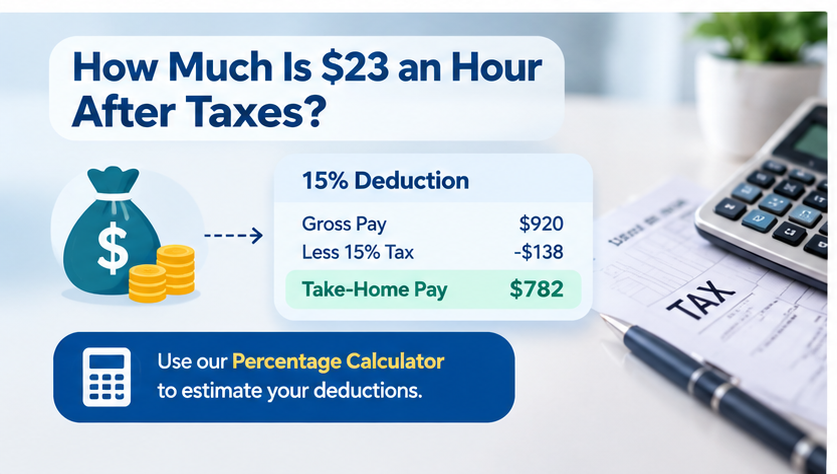
At $23 an hour, your gross annual income is $47,840, assuming you work 40 hours per week for 52 weeks. Your net income, or take-home pay, will be lower after taxes and other deductions.
For example, if your total effective tax rate were 15%, your estimated annual take-home pay would be $40,664.
Here’s the calculation:
- Annual gross income: $47,840
- Illustrative taxes at 15%: $7,176
- Estimated annual take-home pay: $40,664
Important: The 15% rate is only an example, not a guaranteed or personalized tax estimate. Your actual tax liability could be higher or lower depending on your circumstances and location.
Use our Percentage Calculator to calculate percentage-based deductions from your gross pay. This provides an estimate and does not calculate your actual taxes.
How Much Is $23 an Hour After Taxes Per Month?
Your gross monthly income is approximately $3,986.67. Your monthly take-home pay will depend on the taxes and deductions applied to your earnings.
Using the same illustrative 15% effective tax rate:
$3,986.67 × 0.85 = approximately $3,388.67
That would leave you with around $3,389 per month after the assumed tax deduction. Your actual paycheck may differ, particularly if you receive biweekly pay or have additional deductions for health insurance or retirement contributions.
How Much Is $23 an Hour After Taxes Per Week?
If you work 40 hours per week, your gross weekly pay is $920.
Using the illustrative 15% effective tax rate:
$920 × 0.85 = $782
This means your estimated weekly take-home pay would be $782 under that assumption. Your actual amount depends on your tax situation and payroll deductions.
What Factors Affect Your Take-Home Pay?
Several factors can influence how much of your $23-per-hour wage you keep.
1. Federal income tax
If you work in the United States, federal income tax depends on your taxable income, filing status, and applicable tax rules. Different portions of your taxable income may be taxed at different rates.
2. State and local taxes
Some states and local jurisdictions charge income taxes, while others do not. Your location can therefore make a difference in your take-home pay.
3. Social Security and Medicare
Most U.S. employees pay Social Security and Medicare taxes through payroll deductions. These taxes are separate from federal income tax.
4. Tax filing status and deductions
Your filing status, eligible deductions, and tax credits can affect your final tax bill. Two people earning the same hourly wage may have different take-home incomes.
5. Benefits and other payroll deductions
Employer-sponsored health insurance, retirement contributions, and other benefits may reduce the amount deposited into your bank account. These deductions are not all taxes, so it’s useful to distinguish them when reviewing your paycheck.
How to Estimate Your After-Tax Salary
To estimate your take-home pay, start with your gross income and subtract estimated taxes and other payroll deductions.
Net Income = Gross Income − Taxes − Other Deductions
For a more accurate estimate, use a paycheck or salary calculator that accounts for your state, filing status, pay frequency, and deductions. This can help you plan monthly expenses and determine how much money you can comfortably save.
Ultimately, earning $23 an hour provides a gross annual salary of $47,840 under a standard full-time schedule. The amount you actually keep depends on your individual tax situation and employment benefits.
5. Is $23 an Hour a Good Salary?
Earning $23 an hour can be a reasonable income for many workers, but whether it’s a good salary depends on where you live, your household size, and your monthly expenses. At 40 hours per week, this wage equals $47,840 per year before taxes.
For someone living in an affordable area with manageable expenses, this income may cover basic needs and allow some savings. However, people living in expensive cities or supporting a family may find it harder to make ends meet.
Can You Live Comfortably on $23 an Hour?
Living comfortably on $23 an hour is possible, but it requires careful budgeting. Your housing costs, transportation expenses, healthcare, and other financial responsibilities will determine how far your income goes.
Here are some important factors to consider:
- Housing: Rent or mortgage payments are often one of the largest monthly expenses. Lower housing costs leave more money for other needs.
- Transportation: Car payments, fuel, insurance, or public transportation can take a significant portion of your income.
- Food and groceries: Your household size and shopping habits affect how much you spend on meals.
- Healthcare: Insurance premiums, prescriptions, and medical expenses can reduce your available income.
- Savings: Building an emergency fund can help you handle unexpected bills without relying on credit cards or loans.
If you keep these expenses under control, $23 an hour may provide a manageable standard of living. Your situation will be different if you have substantial debt, dependents, or high housing costs.
What Is Your Monthly Budget at $23 an Hour?
With a full-time schedule, your gross monthly income is approximately $3,986.67. Your actual take-home pay will be lower after taxes and any other payroll deductions.
The following example shows how someone might organize a monthly budget using an illustrative take-home income of $3,200. This is a budgeting example, not a guaranteed after-tax estimate.
| Monthly Expense | Example Budget |
| Rent and utilities | $1,100 |
| Groceries | $400 |
| Transportation | $350 |
| Health and medical costs | $200 |
| Phone and internet | $100 |
| Debt payments | $250 |
| Personal expenses | $300 |
| Savings and emergency fund | $500 |
| Total | $3,200 |
Your actual budget may look different depending on your location and personal circumstances. In an expensive area, housing alone could cost considerably more. In a more affordable location, you may have additional money available for savings or other priorities.
Is $23 an Hour Enough to Live Alone?
Living alone on $23 an hour may be achievable if you have affordable housing and limited debt. However, paying all household expenses yourself can make budgeting more difficult .
Before renting an apartment, calculate the full cost of living independently. Include rent, electricity, water, internet, groceries, transportation, insurance, and savings.
For example, if your rent consumes a large share of your take-home pay, you may have little left for emergencies. Choosing a less expensive apartment or sharing housing could give you more financial flexibility.
Can You Support a Family on $23 an Hour?
Supporting a family on $23 an hour can be difficult, especially if you are the only person earning an income. Childcare, healthcare, housing, and groceries can increase household expenses considerably.
A two-income household may find this wage easier to manage. If you are the sole earner, consider your family size, local cost of living, available benefits, and monthly financial commitments before deciding whether the salary is sufficient.
Creating a detailed budget can help you identify areas where you may reduce expenses or increase savings.
How Does $23 an Hour Compare With Other Wages?
Comparing hourly rates can help you understand how small pay increases affect your annual income. The following figures assume 40 hours per week and 52 paid weeks per year.
| Hourly Wage | Annual Gross Income |
| $18 per hour | $37,440 |
| $20 per hour | $41,600 |
| $23 per hour | $47,840 |
| $25 per hour | $52,000 |
| $28 per hour | $58,240 |
| $30 per hour | $62,400 |
At $25 an hour, you would earn $4,160 more annually than at $23 an hour, before taxes. That difference could help cover higher rent, pay down debt, or build your emergency fund.
However, salary is only one part of a job’s value. Health insurance, retirement contributions, paid leave, job security, commuting costs, and opportunities for advancement can also influence your financial well-being.
How to Make $23 an Hour Go Further
If you’re earning $23 an hour, a few practical habits can help you manage your money more effectively.
- Track your expenses: Review your spending to identify unnecessary costs and opportunities to save.
- Set a realistic housing budget: Choose housing that leaves enough income for essential expenses and savings.
- Build an emergency fund: Start with a manageable amount and gradually work toward saving three to six months of essential expenses.
- Manage high-interest debt: Prioritize expensive debt where possible to reduce interest costs over time.
- Look for career growth: Training, certifications, or a better-paying role may help you increase your long-term income.
6. How Does $23 an Hour Compare to Other Wages?
Comparing $23 an hour with other hourly wages can help you understand your earning potential and decide whether a job offer meets your financial goals. Even a small difference in hourly pay can add up to thousands of dollars over a year.
At 40 hours per week and 52 paid weeks per year, $23 an hour equals $47,840 annually before taxes. Let’s see how this compares with lower and higher hourly rates.
A $1 hourly raise may seem small, but it can make a meaningful difference over time.
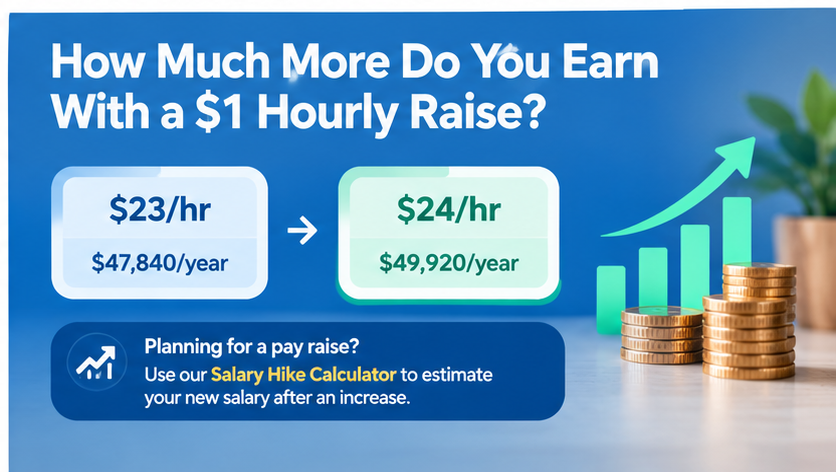
If you work 40 hours per week for 52 weeks, a $1 increase in your hourly wage adds up to:
- $40 more per week before taxes.
- Approximately $173.33 more per month on average.
- $2,080 more per year before taxes.
For example, moving from $23 to $24 an hour increases your annual salary from $47,840 to $49,920. Your actual take-home increase will be lower after taxes and any applicable deductions.
Planning for a pay raise? Use our Salary Hike Calculator to estimate your new salary after an increase.
Is $23 an Hour Better Than a Salary of $45,000?
At first glance, earning $23 an hour may seem similar to receiving a $45,000 annual salary. However, under a standard full-time schedule, $23 an hour produces $47,840 in annual gross earnings.
That is $2,840 more than a $45,000 salary, assuming you receive pay for all 52 weeks.
Before comparing job offers, consider the complete compensation package. A salaried position might include better health benefits, paid leave, retirement contributions, or more predictable income. An hourly position might offer overtime pay but provide fewer guaranteed hours.
Your working schedule also matters. If an hourly employee regularly works fewer than 40 hours per week, their annual earnings may be lower than expected.
How Working Hours Affect the Comparison
Hourly wages only tell part of the story. The number of hours you work can substantially modefiy your annual income.
For example, a person earning $25 an hour for 30 hours per week would make $39,000 annually, assuming 52 paid weeks. Someone earning $23 an hour for 40 hours per week would make $47,840.
This means the lower hourly rate can produce a higher annual income when the employee works more hours.
When comparing wages, calculate your expected yearly earnings using your actual schedule rather than relying on the hourly rate alone.
Which Hourly Wage Should You Aim For?
The right hourly wage depends on your expenses, career goals, and local job market. If $23 an hour covers your important costs and allows you to save, it may be a reasonable starting point. If your expenses exceed your income, you may need to reduce costs, increase working hours, or pursue a higher-paying position.
Use an hourly-to-annual salary calculator to compare different wage rates quickly. It can help you estimate your gross income and understand how a potential raise or new job could affect your finances.
A higher hourly wage does not automatically guarantee a better financial situation. Consider working hours, benefits, taxes, commuting expenses, and job stability before deciding which opportunity offers the best overall value.
7. How Overtime Affects a $23-Per-Hour Salary
If you earn $23 an hour, working overtime can increase your total income beyond your regular annual salary of $47,840. Overtime pay allows eligible employees to earn additional money when they work beyond their regular schedule.
In the United States, eligible nonexempt employees generally receive at least 1.5 times their regular rate for hours worked over 40 in a workweek under federal law. However, overtime eligibility and applicable rules depend on your job, employment status, and state laws.
How Much Is Overtime Pay for $23 an Hour?
If your overtime rate is 1.5 times your regular hourly wage, you can calculate it by multiplying $23 by 1.5.
Overtime Rate = Regular Hourly Wage × 1.5
For someone earning $23 an hour:
$23 × 1.5 = $34.50
This means your overtime rate would be $34.50 per hour when the standard time-and-a-half rule applies.
Here’s how your earnings compare:
| Pay Type | Hourly Rate |
| Regular pay | $23.00 |
| Overtime pay at 1.5× | $34.50 |
| Double-time pay at 2×, if applicable | $46.00 |
Double-time pay is not a general federal requirement for all overtime hours. It may apply under certain state laws, employment agreements, or employer policies.
How Much Can You Earn With 5 Hours of Overtime?
Suppose you work 45 hours in one week, including five overtime hours. If you qualify for time-and-a-half overtime after 40 hours, your weekly pay would be higher than your regular $920.
Your earnings would be calculated as follows:
- Regular pay: 40 × $23 = $920
- Overtime pay: 5 × $34.50 = $172.50
- Total weekly pay: $920 + $172.50 = $1,092.50
With five overtime hours, you would earn an additional $172.50 that week before taxes.
How Much Is $23 an Hour With 10 Hours of Overtime?
If you work 50 hours in one week, including 10 overtime hours, your earnings would increase further.
Here’s the calculation:
- Regular pay: 40 × $23 = $920
- Overtime pay: 10 × $34.50 = $345
- Total weekly pay: $920 + $345 = $1,265
Compared with your regular weekly earnings of $920, you would earn an extra $345 before taxes.
Annual Salary at $23 an Hour With Overtime
Your annual earnings can increase significantly if you consistently work overtime throughout the year. The table below shows estimated annual gross income under different weekly schedules.
These estimates assume 52 paid weeks, a regular 40-hour workweek, and overtime paid at 1.5 times the regular hourly rate for hours over 40.
| Weekly Schedule | Weekly Gross Pay | Annual Gross Pay |
| 40 hours | $920.00 | $47,840 |
| 45 hours | $1,092.50 | $56,810 |
| 50 hours | $1,265.00 | $65,780 |
| 55 hours | $1,437.50 | $74,750 |
| 60 hours | $1,610.00 | $83,720 |
These figures are estimates, not guaranteed earnings. They assume the same overtime schedule every week and do not account for unpaid leave, changes in hours, bonuses, or other payroll adjustments.
Is Working Overtime Worth It?
Overtime can be useful if you want to increase your income, pay down debt, or save for a major expense. However, extra hours also require more time and energy.
Before accepting regular overtime, consider the following factors:
- Additional income: Overtime can help you reach financial goals faster.
- Taxes and deductions: Your take-home pay will be lower than your gross overtime earnings.
- Work-life balance: Longer workweeks can leave less time for family, rest, and personal activities.
- Job requirements: Some employers offer overtime regularly, while others provide it only occasionally.
- Eligibility: Not every employee qualifies for overtime under the same rules.
If you are considering a job that advertises overtime opportunities, ask how often overtime is available and how it is calculated.
How to Calculate Your Pay With Overtime
You can estimate your weekly income by adding regular earnings to overtime earnings.
Weekly Pay = (Regular Hours × Regular Rate) + (Overtime Hours × Overtime Rate)
For example, if you earn $23 an hour, work 40 regular hours, and complete five overtime hours at $34.50 per hour:
(40 × $23) + (5 × $34.50) = $1,092.50
You can then multiply your weekly earnings by the number of weeks you expect to work to estimate your annual income.
A salary calculator that supports overtime can make these calculations easier and help you compare different work schedules.
8. What Jobs Pay Around $23 an Hour?
If you’re looking for a job that pays $23 an hour, several career options may be worth exploring. Opportunities exist in industries such as transportation, healthcare, customer service, administration, sales, and skilled trades.
At $23 an hour, a full-time employee can earn approximately $47,840 per year before taxes. However, your actual earnings will depend on your experience, qualifications, location, employer, and working hours.
1. Delivery Driver
Delivery drivers transport packages, groceries, food, and other products to customers. Some driving positions offer hourly wages around $23, although pay varies by employer and location.
Typical responsibilities include following delivery routes, handling packages, maintaining delivery records, and providing reliable customer service.
Some positions require a valid driver’s license, a clean driving record, or a commercial driver’s license (CDL). Commercial driving jobs may offer different pay rates depending on the type of vehicle, experience, and delivery routes.
2. Administrative Assistant
Administrative assistants help businesses manage everyday office operations. Their responsibilities may include scheduling appointments, answering calls, organizing documents, maintaining records, and assisting other employees.
Experienced administrative assistants may find positions paying around $23 an hour, particularly in organizations that require strong computer, communication, and organizational skills.
This career can be suitable for people who prefer office-based work and enjoy keeping tasks organized.
3. Customer Service Representative
Customer service representatives help customers resolve problems, answer questions, process orders, and understand products or services.
Some positions pay around $23 an hour, especially when they require specialized product knowledge, technical support skills, or previous customer service experience.
Employers may offer remote, hybrid, or office-based opportunities. Strong communication skills, patience, and problem-solving abilities can help candidates qualify for these roles.
4. Medical Assistant
Medical assistants support healthcare professionals with administrative and clinical tasks. Depending on the workplace, their duties may include scheduling appointments, updating patient records, preparing examination rooms, and taking basic patient measurements.
Some positions may offer wages near $23 an hour, depending on location, qualifications, and experience. Certain employers require formal training or certification.
People interested in this career should check the requirements in their state and the qualifications requested by individual employers.
5. Maintenance Technician
Maintenance technicians inspect, repair, and maintain equipment, buildings, and machinery. They may work in factories, apartment complexes, hospitals, hotels, or commercial facilities.
Hourly pay can reach or exceed $23 for workers with relevant technical experience. Employers may look for knowledge of electrical systems, plumbing, mechanical repairs, or preventive maintenance.
Technical training and practical experience can help candidates qualify for better-paying opportunities.
6. Sales Representative
Sales representatives help businesses sell products or services to customers. Their work may involve identifying potential customers, explaining product features, answering questions, and negotiating sales.
Some sales positions offer a base wage around $23 an hour, while others use commissions, bonuses, or a combination of compensation methods.
Before accepting a sales role, review how compensation works. A job advertising potential earnings equivalent to $23 an hour may not guarantee that amount if a significant portion of pay depends on sales performance.
7. Restaurant Server
Restaurant servers take orders, deliver food, answer questions about menu items, and help customers have a positive dining experience.
In some locations, tips can raise total earnings to around $23 an hour or more. However, income can vary significantly depending on the restaurant, customer traffic, shift schedule, and tipping practices.
When evaluating a serving job, distinguish between the base hourly wage and total earnings, including tips.
How to Find Jobs That Pay $23 an Hour
If you want to earn $23 an hour, start by searching for positions that match your existing skills and experience. You can explore job boards, company career pages, staffing agencies, and local employment listings.
Follow these steps to improve your search:
- Search using specific keywords: Try phrases such as “jobs paying $23 an hour,” “entry-level jobs paying $23 an hour,” or “remote jobs paying $23 an hour.”
- Compare job requirements: Review the experience, education, certifications, and skills employers request.
- Check the compensation details: Confirm whether the advertised wage is guaranteed, includes tips, depends on commissions, or requires overtime.
- Calculate annual earnings: Multiply the hourly rate by your expected weekly hours and annual working weeks.
- Consider benefits: Compare health insurance, retirement plans, paid leave, and other benefits alongside the hourly wage.
Are There Entry-Level Jobs That Pay $23 an Hour?
Yes, some entry-level jobs can pay around $23 an hour, depending on the industry, location, employer, and skills required. Certain warehouse, delivery, customer service, and production positions may offer wages near this amount.
However, not every entry-level role reaches this pay level. Some positions require specialized training, an appropriate license, shift work, or physically demanding duties.
If you don’t yet qualify for a $23-an-hour position, consider developing skills that employers value. Training in technology, equipment operation, bookkeeping, customer support, or a skilled trade may expand your employment options.
Can You Earn $23 an Hour Working From Home?
Remote jobs can sometimes pay $23 an hour or more. Potential options include customer support, technical support, sales, bookkeeping, virtual assistance, and certain administrative roles.
Research employers carefully before sharing sensitive information or accepting an offer . Pay depends on the employer, job responsibilities, experience, and whether the position is hourly or salaried. Some remote roles also require specific qualifications or previous experience.
Be cautious of job offers that promise unusually high earnings for very little work, request upfront fees, or ask you to deposit checks and return part of the money.
Conclusion
Earning $23 an hour equals $47,840 per year before taxes when you work 40 hours a week for 52 weeks. Your actual take-home pay depends on taxes, deductions, working hours, and overtime. Whether this is a good salary depends on your location, living expenses, and financial goals. Understanding your weekly, monthly, and annual earnings can help you budget wisely and compare job opportunities. Use a salary calculator to estimate your income and plan your finances with confidence.
Frequently Asked Questions
1. $23 an hour is how much a year after taxes?
At $23 an hour, you earn $47,840 annually before taxes; your after-tax income depends on your tax rate and deductions.
2. $23 an hour is how much a month?
At $23 an hour, you earn approximately $3,986.67 per month before taxes, working 40 hours per week.
3. $23 an hour is how much a year in salary?
Working 40 hours per week for 52 weeks, $23 an hour equals $47,840 per year before taxes.
4. $23 an hour is how much a week?
Working 40 hours per week at $23 an hour, you earn $920 before taxes.
5.How much is $23 an hour for 30 hours a week?
At $23 an hour and 30 hours per week, you would earn $690 per week and approximately $35,880 per year before taxes, assuming you work 52 weeks a year.
6. $23 an hour is how much biweekly?
Working 80 hours every two weeks at $23 an hour, you earn $1,840 biweekly before taxes.
7. $23 an hour is how much a year working 50 hours a week?
Working 50 hours weekly at $23 an hour, you earn $59,800 annually without overtime premiums, or $65,780 if 10 weekly overtime hours are paid at 1.5 times your regular rate.
8. $23 an hour is how much a year working 35 hours a week?
Working 35 hours per week at $23 an hour, you earn $41,860 per year before taxes.