Fake Word Generator: 7 Powerful Ways to Create Unique Words
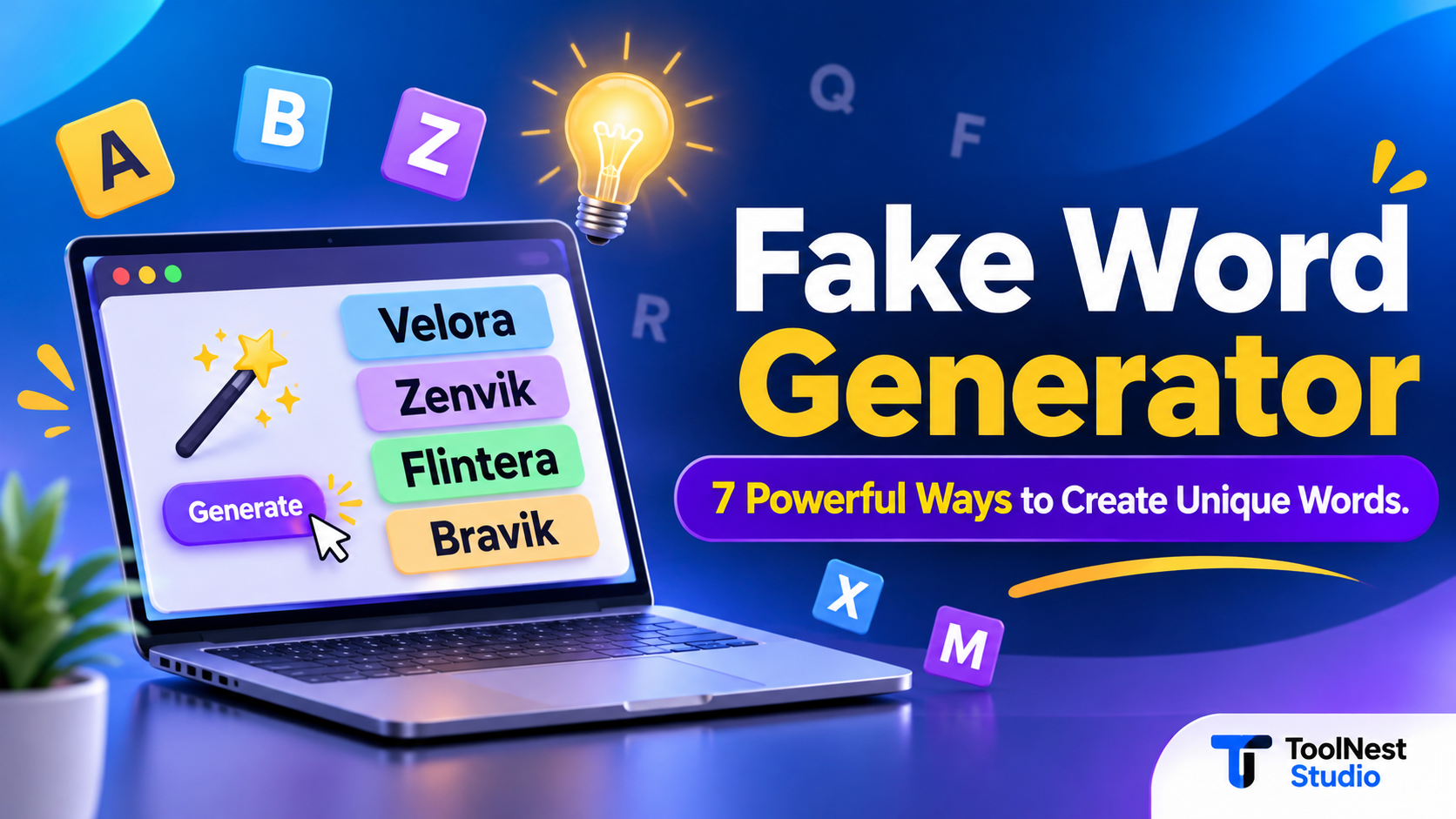
A Fake Word Generator helps you create unique, made-up words for stories, games, creative projects, and naming ideas. These words may sound familiar, but they have no established meaning. You can use them to name fictional characters, invent imaginary places, or develop your own language.
Sometimes, ordinary words do not fit your idea. A random fake word generator can provide fresh inspiration when you need something unusual. You can also create your own words by combining letters, sounds, and syllables.
In this guide, you will learn what fake words are, how they are created, where to use them, and how to make your own. You will also find useful examples and practical tips for choosing words that fit your project.
What Is a Fake Word Generator?
A Fake Word Generator is a tool that creates invented words that may sound like real words but have no established meaning. These words are also called nonsense words, pseudowords, or made-up words.
For example:
| Fake Word | Possible Meaning |
|---|---|
| Velora | A peaceful fantasy village |
| Brintex | A fictional technology |
| Lumora | A glowing object |
| Zenvik | A character’s name |
| Flonary | A made-up activity |
These examples are original word ideas created for illustration. Their meanings are imaginary, and the words should not be assumed to be unused in every language or context.
A random fake word generator can create different combinations of letters and sounds. Some generators use stored word lists, while others build new combinations from sound patterns.
The main purpose is to provide fresh ideas. You can use a generated word as it is or change its spelling and meaning to fit your project.
How Does a Fake Word Generator Work?
A fake word generator can use different methods to produce invented words. The method depends on how the tool is designed.
1. Combining Letters and Sounds
Some generators combine consonants and vowels to create words that are easy to pronounce.
For example:
- Consonant: B
- Vowel: A
- Consonant: R
- Ending: O
These sounds could form a word such as “Baro.”
The generator may use different combinations each time. This creates a variety of possible words without relying on a fixed dictionary.
2. Using Syllable Patterns
A syllable is a sound unit within a word. Fake words often use familiar syllable patterns to make them easier to read and pronounce.
For example:
- One syllable: Vorn
- Two syllables: Belora
- Three syllables: Zameriko
A generator may allow users to choose a syllable count. This can help when creating short names, longer fantasy words, or fictional terms.
3. Selecting Words from a Database
Some fake word generators use a stored collection of invented words. They select words from that list and display them randomly.
This method can produce consistent results. However, it may not create completely new combinations each time.
A database-based generator and an algorithm-based generator can both be useful. The best choice depends on whether you need a large variety of words or a specific style.
7 Powerful Ways to Use Fake Words
Fake words are not limited to entertainment. They can support creative thinking, writing exercises, naming projects, and other activities.
1. Create Names for Fictional Characters
Writers often need names for characters who live in imaginary worlds. A fake word generator can provide ideas that sound different from common names.
For example:
- Zorven
- Melvani
- Torlix
- Virella
You can use these words as starting points for character names. Adjust the spelling or pronunciation if a word does not fit your character.
A fantasy character may need a strong-sounding name, while a friendly character may need a softer one. Try different combinations until you find a suitable option.
2. Build Names for Fictional Places
Invented words can also help you name fictional locations.
You might need a name for a village, mountain, planet, or magical kingdom. Random made-up words can provide inspiration when you cannot think of a suitable name.
For example:
| Fake Name | Fictional Location |
|---|---|
| Eldrava | A mountain kingdom |
| Norvella | A peaceful village |
| Zenthora | A distant planet |
| Bravik | A hidden forest |
You can give each name a meaning that fits your fictional world. This can make your story more consistent and interesting.
3. Use Fake Words for Creative Writing
Writers sometimes face a blank page when starting a new story. A nonsense word generator can provide a simple writing prompt.
Choose a random word and build a short story around it.
For example, imagine the word “Flintera.” You could decide that it is the name of a mysterious object found in an old house.
You can also use fake words in writing challenges:
- Write a paragraph using three invented words.
- Create a story around one random word.
- Give a meaning to five nonsense words.
- Build a fictional language using your own vocabulary.
These activities can help you explore new ideas without worrying about whether every word has a real definition.
4. Make Word Games More Interesting
Fake words can add variety to word games and creative activities.
For example, you can ask players to invent meanings for random words. One player creates a fake word, and the others guess what it might mean.
You can also use invented words in:
- Guess-the-word games
- Classroom vocabulary activities
- Storytelling challenges
- Party games
- Creative spelling exercises
A random fake word generator can provide new prompts for each round. This can make games more varied and encourage players to think creatively.
5. Find Ideas for Brand Names
Invented words can be useful during the early stages of naming a business, product, or project.
A made-up word may be easier to customize than a common dictionary word. It can also give you more flexibility when developing a brand identity.
For example, words such as “Veltrix,” “Nuvora,” or “Zelvani” could inspire fictional brand concepts.
However, a generated word is not automatically a suitable or available brand name.
Before using a word commercially, check:
- Whether another business already uses it.
- Whether the name has an unwanted meaning in another language.
- Whether the domain name is available.
- Whether a relevant trademark already exists.
A fake word generator can support brainstorming, but it cannot replace proper name research.
6. Create an Imaginary Language
Invented words can become part of a fictional language.
You can create a small vocabulary for a fantasy world, game, or story. Start with basic words and give each one a meaning.
For example:
| Fake Word | Meaning |
|---|---|
| Luma | Light |
| Varek | Water |
| Sora | Sky |
| Nemi | Friend |
| Tavor | Journey |
You can then create simple phrases using your invented vocabulary.
For example, “Luma sora” could mean “light of the sky” in your fictional language.
The meanings are entirely your own. You can change the words, create grammar rules, and expand the vocabulary as your project develops.
7. Create Practice Activities for Students
Teachers and students can use nonsense words in language activities.
For example, students can practice reading unfamiliar letter combinations without relying on the meaning of familiar vocabulary.
A teacher might ask students to:
- Read a list of invented words aloud.
- Identify the syllables in each word.
- Create a sentence using a fake word.
- Invent a meaning for an unfamiliar word.
- Compare how different students pronounce the same word.
These exercises can support creative language practice. However, invented words should be selected carefully when used for formal reading instruction, especially for young learners.
Fake Word Generator vs. Nonsense Word Generator
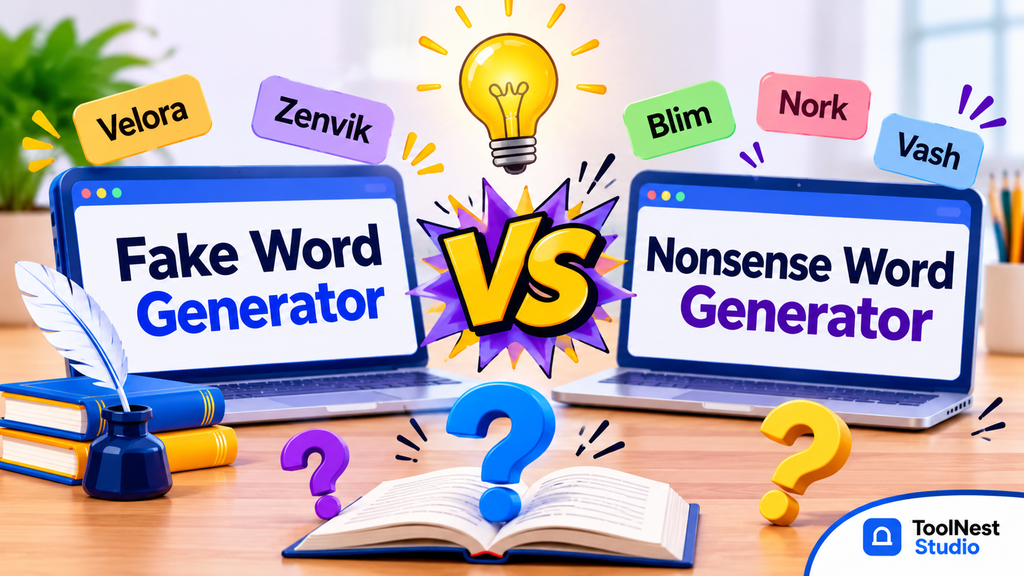
The terms fake word generator and nonsense word generator are often used in similar ways. However, their meanings can differ depending on the purpose.
| Feature | Fake Word Generator | Nonsense Word Generator |
|---|---|---|
| Main purpose | Create invented words | Create words without established meaning |
| Common uses | Naming, stories, games | Language practice, creative activities |
| Word style | Can sound realistic or unusual | Often designed around sound patterns |
| Examples | Velora, Zenvik | Blim, Nork, Vash |
A fake word may be designed to sound like a real name or brand. A nonsense word may focus more on unusual sound combinations.
The difference is not always strict. Many generators can produce both types of words.
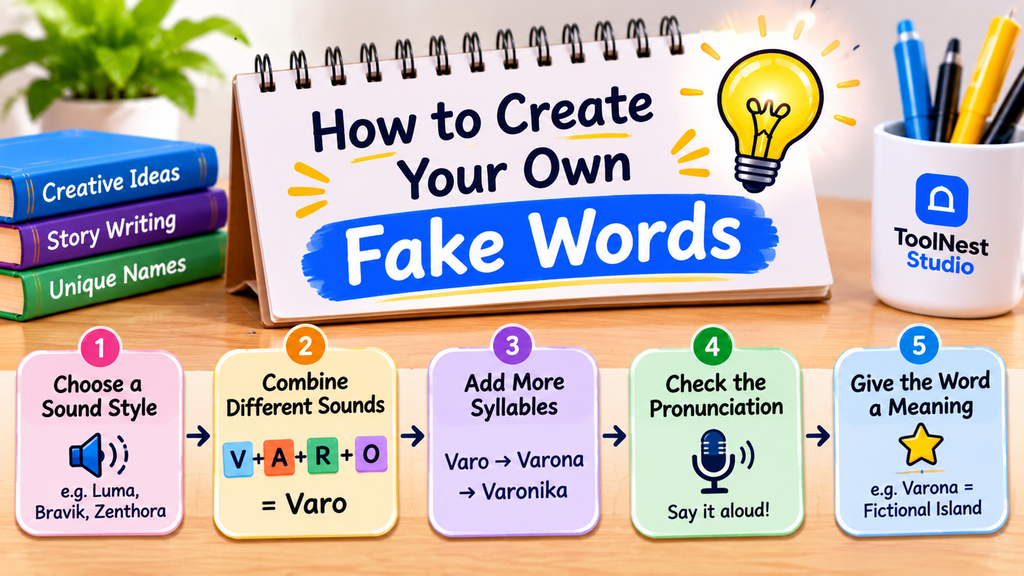
How to Create Your Own Fake Words
You do not always need a generator to create an invented word. You can make your own by combining letters, sounds, and syllables.
Here is a simple process.
Step 1: Choose a Sound Style
Decide how you want the word to sound.
For example:
- Soft: Luma, Velora
- Strong: Bravik, Torven
- Magical: Zenthora, Elvani
- Strange: Flomix, Zarbun
The sound style can help you create words that fit your purpose.
Step 2: Combine Different Sounds
Choose a consonant, a vowel, and an ending.
For example:
- Start with “V”
- Add “A”
- Add “R”
- Finish with “O”
This creates “Varo.”
You can experiment with different combinations until you find something interesting.
Step 3: Add More Syllables
If you need a longer word, add another syllable.
For example:
- Varo
- Varona
- Varonika
Longer words may work well for fantasy places or fictional characters. Shorter words may be easier to remember.
Step 4: Check the Pronunciation
Read the word aloud.
If it is difficult to pronounce, try changing a letter or removing a syllable. A word that sounds natural may be easier for readers to remember.
Step 5: Give the Word a Meaning
Once you have a word, decide what it means.
For example, “Varona” could be the name of a fictional island. “Bravik” could describe a type of machine in a science-fiction story.
Giving a word a meaning can turn a random combination of letters into a useful creative idea.
Tips for Choosing the Best Fake Words
Not every generated word will be suitable for your project. Use these tips to select words that work well.
- Keep it readable: Choose words that people can understand and pronounce.
- Match the purpose: A fantasy name may need a different sound from a fictional product name.
- Avoid confusing spelling: A word that is difficult to spell may be harder to remember.
- Check the meaning: A word may have an existing meaning in another language.
- Test different options: Generate or create several words before choosing one.
- Research commercial names: Check trademarks, domains, and existing businesses before using a word as a brand.
These simple checks can help you turn random word ideas into something more useful.
Frequently Asked Questions
What is a fake word generator?
A fake word generator is a tool that creates invented words with no established meaning. These words can be used for creative writing, games, fictional names, and other activities.
What is the difference between fake words and nonsense words?
Fake words are invented words that may sound like real words. Nonsense words are also meaningless, but they are often used for language practice or creative exercises. The terms can overlap.
Can I use fake words for creative writing?
Yes. Fake words can help you name characters, create fictional places, develop imaginary languages, and overcome writer’s block.
Are generated fake words guaranteed to be unique?
No. A generated word may already exist in a dictionary, another language, a business name, or a trademark. Always check important words before using them publicly or commercially.
Can fake words be used as brand names?
Yes, invented words can inspire brand names. However, you should check existing trademarks, domain availability, pronunciation, and possible meanings before choosing a name for a business.
How can I make my own fake words?
You can combine consonants, vowels, and syllables to create new word patterns. Read the result aloud, adjust its spelling, and give it a meaning that fits your project.
Conclusion
A Fake Word Generator can be a useful source of inspiration for anyone who needs fresh word ideas. From fictional characters and fantasy locations to creative writing and word games, invented words offer many ways to explore your imagination.
You can also create your own words by combining letters, experimenting with sounds, and assigning meanings to the results.
The most useful fake word is not always the strangest one. It is the word that fits your purpose, sounds right, and helps you develop your idea.