
How to Calculate My GPA: 5 Easy Steps (2026 Guide)
How to Calculate My GPA is a common question for students who want to understand their academic performance. GPA shows the average points you earn from your course grades and credit hours.
Calculating it is simple when you know the correct formula and grading scale. In this guide, you will learn how to calculate your GPA step by step, understand the 4.0 grading scale, and see practical examples. You will also learn the difference between GPA and CGPA so you can better understand your academic results.
1. Understand How the GPA System Works
Before calculating your GPA, you need to understand how the grading system works. Most colleges and universities use a grade point scale to measure student performance.
A common system uses a 4.0 scale. In this system, each letter grade has a numerical value.
| Letter Grade | Grade Points |
|---|---|
| A | 4.0 |
| B | 3.0 |
| C | 2.0 |
| D | 1.0 |
| F | 0.0 |
Some schools also use plus and minus grades, such as A-, B+, and C-. Their point values depend on the institution.
Your university may also use a different grading scale. Always check your school’s official grading policy before calculating your GPA.
2. Find the Information Needed to Calculate My GPA
You need three main things to calculate your GPA:
- Course grades: The final letter grade you received in each subject.
- Grade points: The numerical value assigned to each letter grade.
- Credit hours: The number of credits assigned to each course.
Credit hours matter because not every course has the same academic weight. A course with more credit hours has a greater effect on your GPA.
For example, a three-credit course affects your GPA more than a one-credit course if both have the same grade.
3. How to Calculate My GPA Using the GPA Formula
The GPA formula helps you find your average grade points across all courses.
GPA Formula:
GPA = Total Quality Points ÷ Total Credit Hours
To find quality points for each course, multiply its grade points by its credit hours.
Quality Points = Grade Points × Credit Hours
For example, if you earn 4.0 grade points in a three-credit course:
4.0 × 3 = 12 quality points.
Repeat this calculation for every course. Then add all quality points and divide the result by your total credit hours.
4. How to Calculate My GPA With Credit Hours
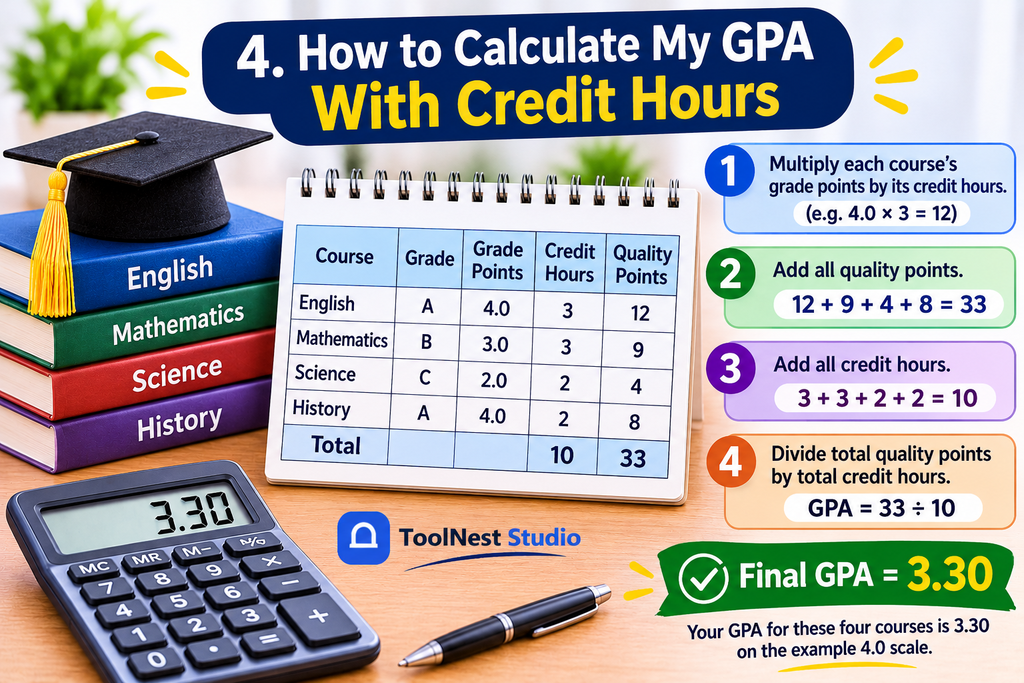
Now let’s use a practical example to understand how to calculate GPA with credit hours.
Suppose you complete four courses with the following grades and credits:
| Course | Grade | Grade Points | Credit Hours | Quality Points |
|---|---|---|---|---|
| English | A | 4.0 | 3 | 12 |
| Mathematics | B | 3.0 | 3 | 9 |
| Science | C | 2.0 | 2 | 4 |
| History | A | 4.0 | 2 | 8 |
| Total | 10 | 33 |
Follow these steps:
Step 1: Multiply each course’s grade points by its credit hours.
Step 2: Add all quality points.
12 + 9 + 4 + 8 = 33
Step 3: Add all credit hours.
3 + 3 + 2 + 2 = 10
Step 4: Divide total quality points by total credit hours.
GPA = 33 ÷ 10
Final GPA = 3.30
Your GPA for these four courses is 3.30 on the example 4.0 scale.
5. How to Calculate My GPA on a 4.0 Scale
A 4.0 GPA scale is commonly used by colleges and universities in the United States. It converts letter grades into numerical points.
To calculate your GPA on this scale, first check the grade point value for each subject. Then multiply each value by its credit hours.
For example, suppose you receive these grades:
- English: A (4.0)
- Mathematics: B (3.0)
- Biology: A (4.0)
- History: C (2.0)
If all four courses have equal credit hours, add the grade points and divide by four.
GPA = (4.0 + 3.0 + 4.0 + 2.0) ÷ 4
GPA = 13 ÷ 4
Final GPA = 3.25
If your courses have different credit hours, use the weighted GPA formula instead.
Remember that a 4.0 scale is not used by every institution. Some universities have different grade values and grading rules.
6. How to Calculate My GPA for One Semester
Semester GPA measures your academic performance during a single semester. It includes the courses you completed during that period.
To calculate your semester GPA:
- List all courses completed in that semester.
- Write the grade points for each course.
- Multiply each grade point by its credit hours.
- Add the quality points.
- Divide the total by all semester credit hours.
For example, if you earn 24 quality points across 8 credit hours:
Semester GPA = 24 ÷ 8
Semester GPA = 3.00
This result represents your average performance for that semester only. It does not include grades from previous semesters.
7. How to Calculate My Cumulative GPA
Cumulative GPA measures your academic performance across multiple semesters. It includes the courses and credits counted toward your overall GPA.
You can calculate cumulative GPA by adding the quality points from all included semesters and dividing them by the total credit hours.
Cumulative GPA Formula:
Cumulative GPA = Total Quality Points from All Semesters ÷ Total Credit Hours from All Semesters
For example:
| Semester | Quality Points | Credit Hours |
|---|---|---|
| Semester 1 | 24 | 8 |
| Semester 2 | 27 | 9 |
| Semester 3 | 30 | 10 |
| Total | 81 | 27 |
Now divide the total quality points by the total credit hours.
Cumulative GPA = 81 ÷ 27
Final Cumulative GPA = 3.00
This method gives you an overall average across all three semesters.
8. Difference Between GPA and CGPA
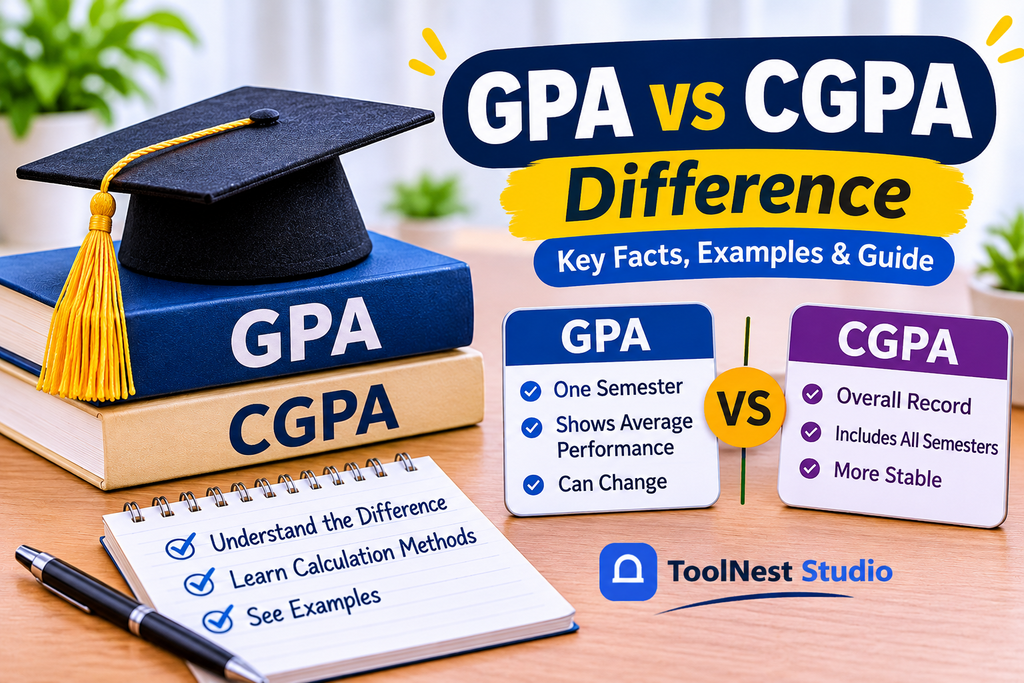
GPA and CGPA both measure academic performance, but they cover different study periods.
| GPA | CGPA |
|---|---|
| Measures performance for a specific semester. | Measures overall performance across multiple semesters. |
| Includes grades from one study period. | Includes grades from all included study periods. |
| Can change after every semester. | Changes as new semester results are added. |
For example, you may earn a 3.50 GPA in your first semester and a 3.00 GPA in your second semester. Your CGPA combines the results of both semesters using their credit hours.
If you want to convert your overall CGPA into a percentage, you can also use a CGPA to Percentage Calculator. However, the conversion method depends on your university’s rules.
9. Common Mistakes to Avoid When Calculating GPA
Small mistakes can lead to an incorrect GPA result. Keep these points in mind:
- Ignoring credit hours: Do not give every course equal weight when their credit hours are different.
- Using the wrong grade scale: Check your university’s official grade point values.
- Mixing semester GPA and cumulative GPA: They measure different academic periods.
- Leaving out courses: Include all courses that count toward your GPA under your institution’s rules.
- Rounding too early: Keep the original values during calculations and round the final result according to your school’s policy.
Checking these details can help you get a more accurate GPA.
10. Frequently Asked Questions About How to Calculate My GPA
1. How Do I Calculate My GPA From Grades?
Convert each letter grade into its numerical grade point value. Multiply each value by the course credit hours, add the quality points, and divide by the total credit hours.
2. How Do I Calculate My GPA on a 4.0 Scale?
Use your school’s 4.0 grading scale to convert letter grades into grade points. Multiply each grade point by its credit hours and divide the total quality points by total credits.
3. How Do I Calculate My College GPA?
List your college courses, grades, and credit hours. Convert the grades into points, calculate the quality points, and divide their total by the total course credits.
4. How Do I Calculate My GPA for One Semester?
Use only the courses included in that semester. Multiply each course’s grade points by its credit hours, add the results, and divide by the semester’s total credit hours.
5. Is GPA the Same as CGPA?
No. GPA usually measures academic performance for one semester, while CGPA measures overall performance across multiple semesters. Some institutions use these terms differently.
6. Can I Calculate My GPA Without Credit Hours?
You can calculate a simple average if all courses have equal weight. However, if courses have different credit hours, you need those values to calculate an accurate weighted GPA.